All posts

The SaaS Apocalypse Isn't Real. But the Market’s Correction Is.

Brad
Founder & CEO
Mar 05, 2026
Hero Actions

It took me over three months of interviewing to get hired at Robinhood as a Software Engineering (SWE) Manager. Even though I had already been working there for over a year, under the first version of our company.  It wasn’t because they were interviewing other candidates, or their was a hiring freeze, or a disconnect about money, it was because they did not understand the different between software engineering and system engineering, and I was doing a very unique job that combined them both.

It was painful. Not only for me, but for the recruiting team. Partially because while I was interviewing for a job I already had as a non-FTE, I was also one of the top five interviewers company-wide for the growing Finance Engineering team I was building in preparation for the IPO. The recruiters knew me well. I was known for making good hires. To this day, the team I built has one of the lowest turnover rates and highest tenure at the company.

The problem was that Robinhood was a software engineering company. And even though it was full of some of the smartest engineers in Silicon Valley, almost none of the 2,300 employees at the time knew what a Systems Engineer was. It literally took months to get the Software Engineering hiring managers to see the difference, and later became a major Compensation project led by our team to create separate pay bands for two types of roles within the Engineering job family.

I bring this up because the same thing is happening in AI right now.

Systems Engineering Was Created for the Military. It's Changing There First.

Systems engineering as a discipline came out of the military-industrial complex in the 1940s and 50s. Bell Labs and the US Department of Defense created it to manage the complexity of large-scale weapons and telecommunications systems where thousands of components from different vendors had to work together reliably. The problem was not building any single component. It was making sure the radar talked to the missile system talked to the command center talked to the communications network.

That discipline migrated to enterprise software in the 1990s when ERP implementations became the corporate equivalent of the same problem. You had an Oracle or SAP system that needed to talk to the general ledger, the sub-ledgers, the bank, the procurement system, the warehouse, the reporting layer. The job was not writing code. It was understanding how to configure, integrate, and orchestrate pre-built components across a complex business process.

Here is the distinction that matters: systems engineers were created because the systems already existed and someone needed to make them work together. Software engineers were created because the systems did not exist yet and someone needed to build them.

For 30 years, the SaaS vendors built their entire ecosystem around systems engineering. Their partners, their certifications, their implementation methodology, their pricing. All designed for people who configure existing things. That ecosystem generated hundreds of billions in services revenue for consulting firms and created an entire professional class of Oracle DBAs, SAP Basis administrators, Workday configurators, and ServiceNow flow designers.

AI is collapsing the wall between these two worlds. And it is collapsing in one direction.

A good systems engineer already understands the data models, the business processes, the integration patterns, and the edge cases that make enterprise software hard. Those are the things that take years to learn. What they did not have was the ability to write code. AI has removed that barrier. Claude Code, GitHub Copilot, Cursor, and a dozen other tools mean that a sharp Oracle functional consultant who understands the Payables data model can now build an AI agent that automates invoice processing. They could not do that two years ago. They can do it today.

Software engineering is eating systems engineering. Not because systems engineers are being replaced. The best ones are converting. And every one that converts kills the business model of the legacy SaaS ecosystem that depended on them staying in their lane.

The Military Figured It Out First. Again.

Just like systems engineering started with the military and migrated to private enterprise, the shift to forward-deployed software engineering is following the same pattern. The US Department of Defense is leading. And every major AI company is racing to serve them.

Palantir signed a $10 billion, 10-year enterprise agreement with the US Army, consolidating 75 separate contracts into a single arrangement. Think about that. 75 contracts. That is 75 instances of the old systems engineering model: separate vendors, separate integrators, separate configurations. Replaced by one platform with embedded software engineers. Palantir has even built an AI-powered Forward Deployed Engineer agent that has become a key driver of their 51% operating margins.

OpenAI just signed a deal to deploy its models across classified Pentagon systems, with cleared forward-deployed OpenAI engineers embedded directly with the military. Not consultants. Not integrators. Software engineers from the AI company, on-site, building.

Anthropic was the first AI lab to deploy models on the DoD's classified network. Claude was used in live military operations before the recent contract dispute made headlines. Regardless of how the politics play out, the pattern is clear: the Pentagon chose to work directly with AI software engineering companies, not through the traditional systems integrator model.

Here is what all three have in common, and it is the thing that should terrify every legacy SaaS vendor: none of their products have a systems engineering layer. Zero. There are no Palantir functional consultants. There is no OpenAI Frontier configuration certification. There is no Claude Cowork implementation methodology with a 200-page runbook. The product is the software. When you need help, they send a software engineer. When you need customization, a software engineer builds it. When something breaks, a software engineer fixes it.

The entire legacy SaaS business model depends on a systems engineering ecosystem: implementation partners, certified consultants, configuration specialists, managed service providers. That ecosystem generates more revenue than the software licenses themselves. Oracle, SAP, Workday, and ServiceNow did not just build products. They built an industry of people who configure those products. And every one of these AI companies just proved you do not need any of it.

That is the real correction. Not the products. The ecosystem.

Anthropic separately partnered with Accenture to train 30,000 professionals on Claude deployment. These are not systems engineering certification programs. They are converting consultants into software engineers using AI tools. Accenture is not training people to configure Claude. They are training people to build with it.

The military figured out the difference first. Again. Private enterprise is about 5-10 years behind. Again. History is repeating itself.

Two Types of AI Products. Only One Has a Future.

There are two types of AI products being marketed to enterprises today. One is built for systems engineers. The other is built by software engineers.

The products from legacy SaaS vendors like Oracle, SAP, Workday, and ServiceNow are built for systems engineers. They live inside the application. They are constrained by the platform's architecture, its data model, its permissions framework. They are, by design, limited to what the platform allows. These are the AI features your vendor promised in the last release. The AI Marketplace. The AI Agent Studio. The drag-and-drop workflow builder with an "AI" badge on it.

These products have a ceiling. And enterprises are hitting it.

At the same time, a growing list of AI companies are building products that sit outside these platforms entirely. Cohere North embeds its models inside Oracle and SAP to become the intelligence layer. Palantir AIP pulls data out of your ERP into its own Ontology. OpenAI just launched Frontier, a platform explicitly designed to manage agents that run your Salesforce and Workday for you. Anthropic's Claude Cowork ships with enterprise plugins for finance, HR, engineering, and operations that automate the same workflows these SaaS vendors charge you to perform manually.

These are software engineering products. Built by people who write code for a living, not people who configure screens and drag workflow rules into a canvas. And increasingly, built by former systems engineers who converted.

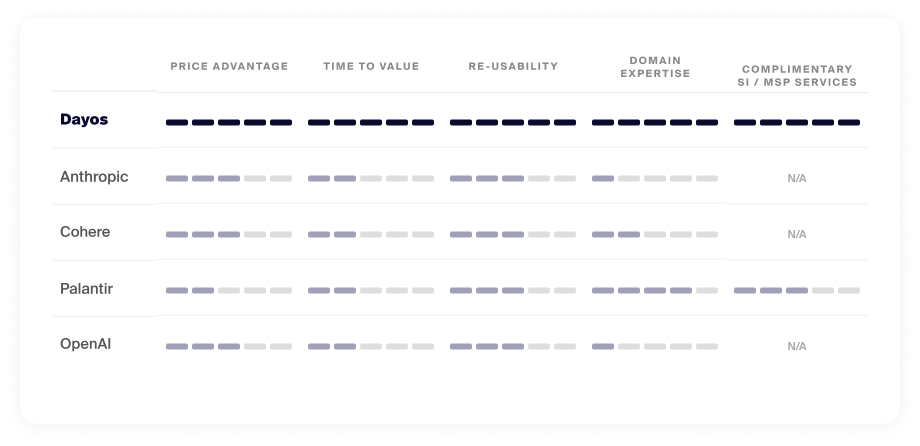
[TABLE 1: The AI Landscape]Five AI platforms. Three strategies. Only one protects your ERP investment.

[IMAGE 1: "There's a gap in the market - and enterprises are stuck in it."]


Stuck in the Middle (Where the Opportunity Is)

What has been hardest for a startup like Dayos, an AI company with embedded engineers focused on back-office systems, is that we sit exactly at the conversion point between these two worlds.

About two-thirds of the time, I am explaining to customers who think we deploy AI using systems engineers what software engineers actually do for a living. These are the Oracle admins, the SAP functional leads, the Workday configurators. They have been told by their vendors that AI is a feature of the platform. They are waiting for it to show up in their next release. It is not coming. Not in the way they think.

The other third of our customers already know software engineering. They are IT leaders, CTOs, VPs of Engineering. Their problem is different. They tried to build AI themselves and it did not work out. Either because the legacy SaaS systems were too hard to work with (undocumented APIs, rigid data models, arcane business logic), or more often, because their software engineers did not understand the data and business processes that the legacy systems performed for their users.

This is the gap. And it is closing fast, from both sides. Systems engineers are learning to code with AI tools. Software engineers are learning ERP domain knowledge by working alongside systems engineers. The conversion is happening right now.

Dayos exists at that intersection. We are not a SaaS platform. We are not an LLM company. We are forward-deployed engineers who already made the conversion: deep systems engineering expertise in Oracle, SAP, Workday, and ServiceNow, combined with the software engineering required to build real AI agents. We are proof that the conversion works. And we are helping our customers make the same transition.

The "SaaSpocalypse" Is a Correction, Not a Collapse

When I see the headlines about a SaaS apocalypse, I see something I have seen before. It is a correction driven by the market finally understanding that software engineering is eating systems engineering.

The stock market rewards future expectations today. And the future expectations it priced into these SaaS companies assumed their AI products would deliver real agentic capabilities through the same systems engineering model they have always used. The market is starting to realize those expectations are not panning out. The platform-native AI products have a ceiling. The consulting firms built to implement them are pivoting to AI companies. And the best systems engineers are converting to software engineers, taking their domain knowledge with them and leaving the legacy ecosystem behind.

Just like at Robinhood, the industry has figured out the difference. No amount of analyst day presentations or Jim Cramer segments is going to fix that.

The SaaS apocalypse is not real. Oracle, SAP, Workday, and ServiceNow are not going away. They remain the systems of record for the world's largest enterprises.

But what is real is a long-overdue stock adjustment, decades in the making, to the monopoly that is enterprise software. Four factors are driving it:

1. The unified platform strategy does not work for company-wide agentic AI. SaaS vendors built their businesses on the promise that one platform could do everything. AI breaks that model. Agentic workflows cross system boundaries by definition. An AP automation agent needs to read from Oracle, validate against a bank portal, update a spreadsheet, and notify a human in Slack. No single SaaS platform can do that. Software engineers build across boundaries. Systems engineers work within them.

2. SaaS systems have been demoted from tools to databases. These platforms were once valued for their process automation and analytics. AI has reduced them to systems of record. The intelligence layer is moving outside the platform. Whether it is Cohere embedding inside Oracle, Palantir pulling data into Foundry, or Claude Cowork bypassing the platform entirely, the value is shifting to whoever owns the AI workflow, not whoever stores the data. The systems engineering layer that sat on top of these platforms is being replaced by a software engineering layer.

3. Decades of stagnation are catching up. These systems have not fundamentally changed in 20 years. The screens look the same. The workflows work the same. The integration patterns are the same. Meanwhile, with the exponential increase in software development velocity driven by AI itself, better products are being released every month to pair with, and increasingly replace, what these platforms do. Every new AI coding tool makes it easier for a systems engineer to cross over and build something better than what the vendor provides.

4. The systems engineering ecosystem is converting. SaaS vendors cannot leverage forward-deployed engineering models because they outsource implementation work to partners who are themselves converting. The big consulting firms, Accenture, BCG, Cognizant, are signing partnerships not with SaaS vendors for implementation projects, but with AI companies that have embedded software engineers. Accenture's 30,000-person Anthropic Business Group is the most visible example. They are not training those people to configure SAP. They are training them to build AI agents. The systems engineering workforce is converting to software engineering. And they are taking their clients with them.
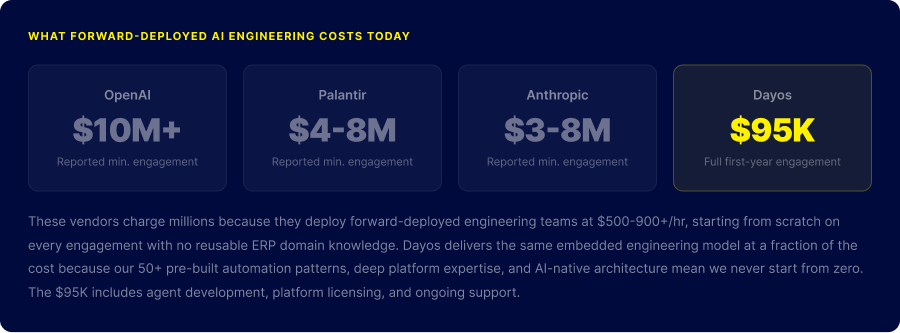
[IMAGE 2: "What Forward-Deployed AI Engineering Costs Today" - pricing comparison]
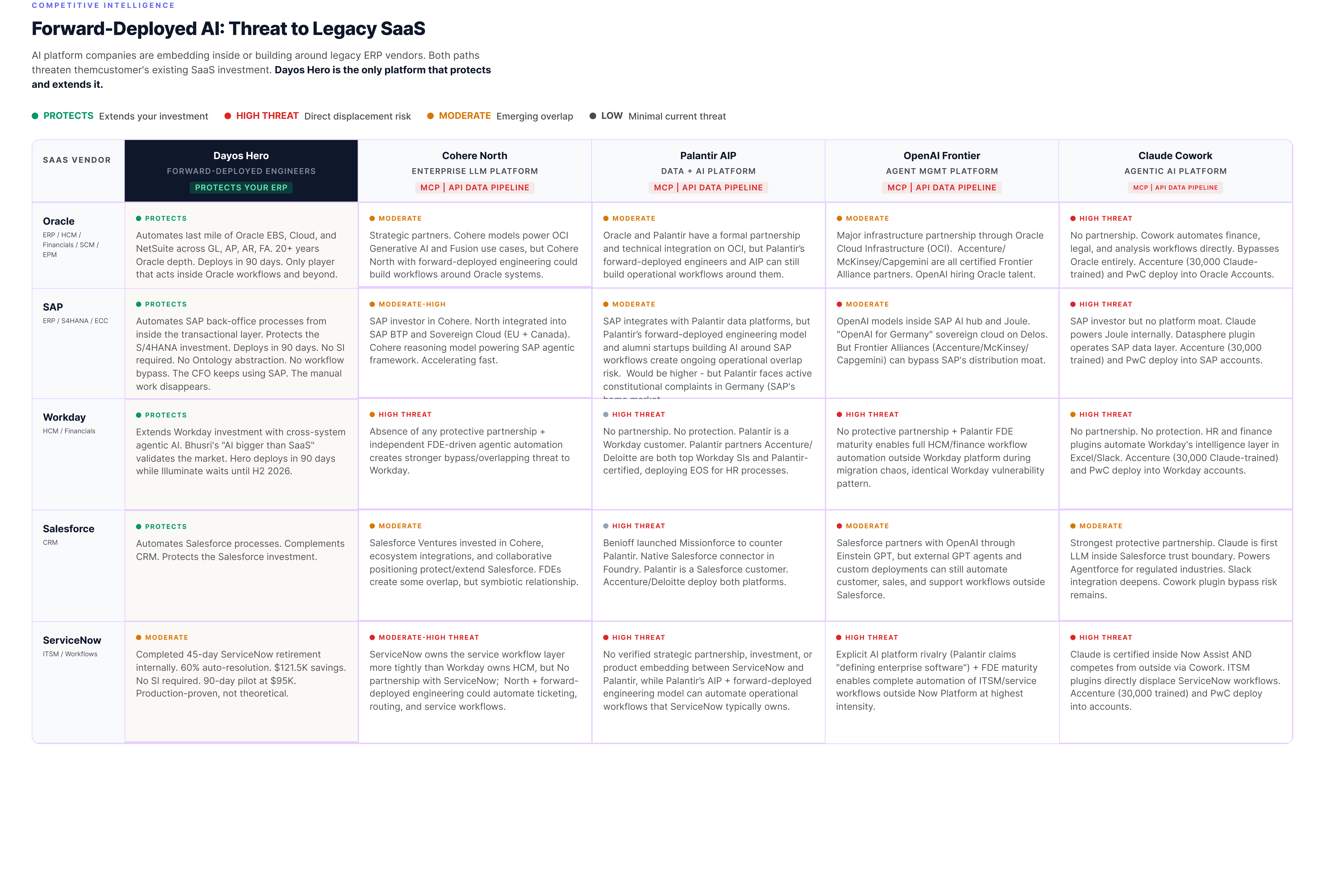
[TABLE 2: Threat to Legacy SaaS]How each AI platform threatens the four dominant enterprise SaaS vendors.

Where Dayos Fits

To help demystify what is happening, and how software engineers are reinventing the world of systems engineering, we created the comparisons throughout this post.

Every other AI platform either embeds inside your ERP to hollow it out, or builds a parallel system to bypass it entirely. Dayos Hero is the only forward-deployed engineering model that automates the last mile of your existing ERP investment. We protect the $5-50M you have already spent and deliver $100K-500K in annual ROI within 90 days.

We built Dayos specifically for this conversion. Our team has 20+ years of systems engineering experience across Oracle, SAP, Workday, and ServiceNow. We made the conversion to software engineering. We know what the data models look like. We know what the business processes do. And we can build AI agents that work with these systems, not against them, because we have lived on both sides.

The best systems engineers in the world are converting right now. The question for every enterprise is whether you are going to help your team make that conversion, or wait until the market makes it for you.

The SaaS apocalypse is not happening. But the correction is here. Software engineering is eating systems engineering. The military figured it out in the 1940s when they created the field. They are figuring it out again now as they replace it. The rest of the enterprise world will follow.

The companies that understand the conversion are the ones that will capture the value.

Share this post