:quality(85)&w=1536&q=85)
:quality(85)&w=1536&q=85)
The VC kingmakers are conspiring. a16z says it's Workday's last workday. YC is funding AI-native everything.
We've been writing about these companies since March, well before a16z and YC released their positions. Not out of disdain or spite, but as a wake-up call to something very alarming we are seeing with these legacy systems of record and how their architecture works.
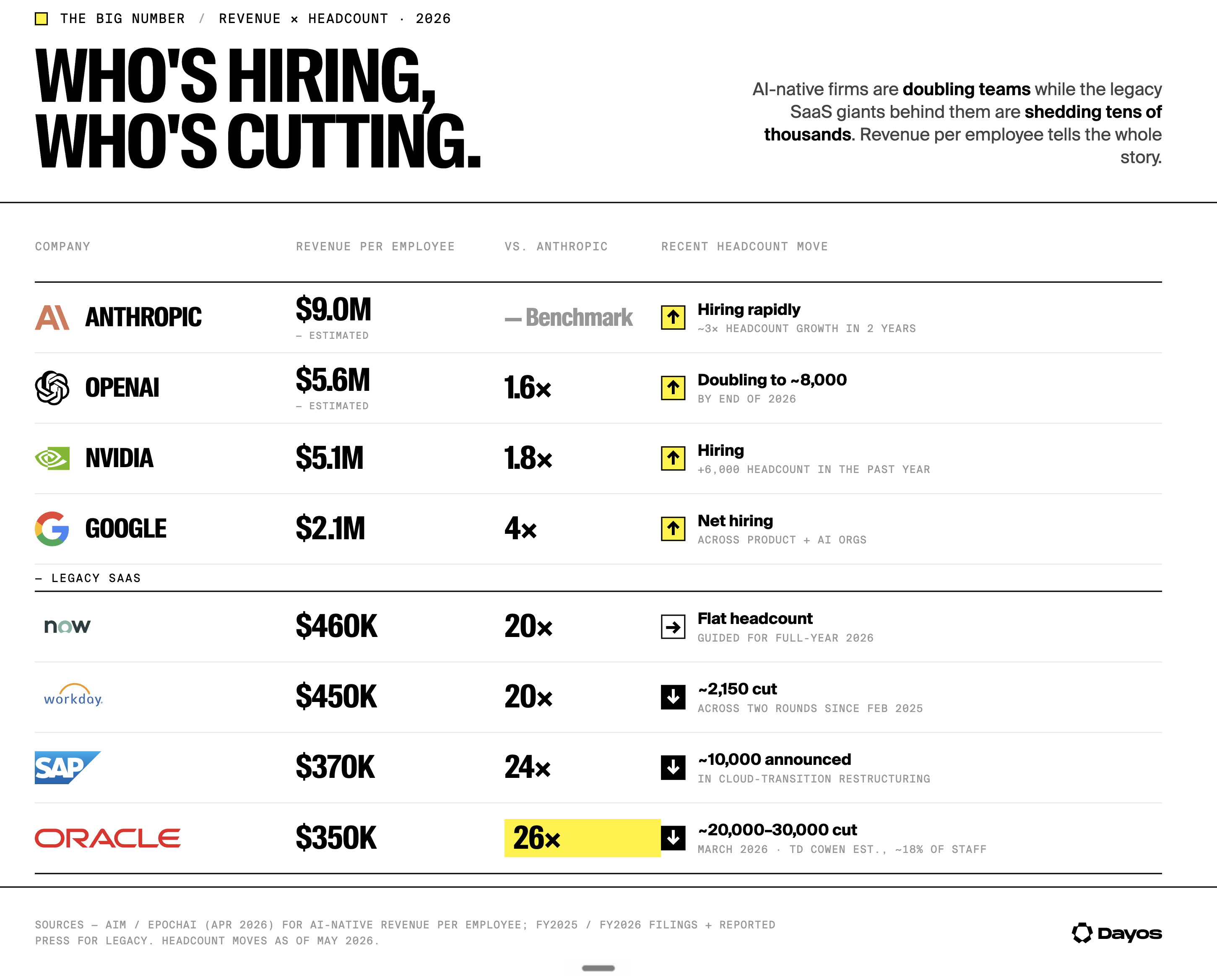
Workday and ServiceNow, in particular, are the best examples here because they are the least diversified and have been impacted the most. They are also smaller than Oracle and SAP, so they have less sand in their hourglasses before time is up. But the apps' revenue of all of the SaaS giants could end up the same, from Salesforce to SAP.
The Systems Engineering Trap
Mark Cuban calls it the Innovator's AI Dilemma, a riff on Clayton Christensen's classic framework. He posted it on X on April 5, 2026, and the framing is sharp: public company CEOs face a lose-lose choice. They either need to tear everything down and rebuild from scratch as an AI-native company, or sit around and wait and do nothing while the stock price erodes. Cuban predicts two waves of shareholder lawsuits incoming, one against companies that opt for the teardown and crash the stock, and another against companies that fail to act and let AI-native startups eat their lunch. In his words: "I think most CEOs don't come close to understanding AI in enough detail to even begin to consider these decisions."
Boris Cherny, the creator of Claude Code at Anthropic, said the quiet part out loud at Sequoia AI Ascent 2026. The reason large companies can't move is not the technology. It's that "the large company has to evolve their business process. They have to evolve the way they work. They have to retrain everyone to use technology. They're going to face a lot of internal resistance to that." That's Cuban's lose-lose, viewed from the operator's seat.
It's surprisingly clear how many of these companies are choosing to sit around and wait. But they're not being complacent. They are actually spending more money on fake marketing and press releases for AI than they have actual AI to ship.
And it goes further than press releases. The fake marketing has moved into the org chart. Pull up LinkedIn profiles at ServiceNow and Accenture now carrying the title "Forward Deployed Engineer." Many show no public commit history, no open source presence, and no shipped software you can point to. The ones that do show technical work tend to show platform configuration, not engineering output. That raises a fair question about what is being engineered versus rebadged. Salesforce ran the cleanest example of this. They announced Headless 360 at TDX 2026, which was the right direction. Everything exposed as an API, MCP tool, or CLI. Native React. Coding agents with full platform access including Claude Code, Cursor, Codex, and Windsurf. That is a real software engineering roadmap. In the same news cycle they announced the FDE Partner Network, with Accenture and Deloitte as launch partners joined by Capgemini, Cognizant, IBM Consulting, KPMG, PwC, Slalom, Tata Consultancy Services, and more than 20 additional firms. The same SIs who have configured the platform for 20 years, rebadged. Accenture is not recruiting computer science graduates into these roles, at least not today. Those two announcements cannot both be true.
One of the most common practices we are seeing among Workday customers right now is building their own MCP servers because they cannot rely on Sana, and connecting them to their internal tools, usually Copilot or Claude, is just easier. We've seen demand for this use case higher than anything else we've released.
It's not that Legacy SaaS doesn't realize this. The infrastructure itself is unbelievably archaic to rebuild for AI, especially considering none of these companies has ever built applications this new way. Their current product teams exist to keep the lights on. And very little recruiting is going on at top-tier schools to get engineering talent that could even solve the problem.
These platforms were architected before the practices that define modern software engineering existed as a stack: distributed version control (Git, 2005), public code hosting (GitHub, 2008), CI/CD, microservices, infrastructure as code, API-first design, polyglot open-source toolchains, trunk-based development, pull request review.
Oracle Applications were built when "version control" meant patch sets shipped quarterly on physical media and applied with adpatch. Workday was built by founders who came from PeopleSoft and reproduced the same closed paradigm in a cloud wrapper: a proprietary internal language, no customer access to source or schema, customization through forms-based metadata tasks rather than commits to a repo. ServiceNow followed the same playbook with the Now Platform, a metadata-driven runtime where customer extensibility flows through scoped applications, business rules, and UI policies, all configured in forms behind a vendor-controlled UI. SAP layered another generation of complexity on top of ABAP, an internal language that has been carried forward since the 1980s mainframe era.
All four systems were architected around a "configure, don't code" paradigm where the vendor owns the engineering and the customer (or their SI) owns the configuration. Extensibility is through tables and forms, not pull requests against an SDK. There is no repo for a customer to fork. There is no service boundary you can replace. The platform is a closed runtime, and the customer's only lever is metadata inside a UI the vendor controls.
That is the architectural reality the AI-Native Services thesis is pushing against.
Boris Cherny put a finer point on it at AI Ascent 2026 using Hamilton Helmer's Seven Powers framework. Two of the moats that legacy ERP and ITSM vendors have relied on for decades are now eroding fast. Switching costs are going away because "you can just use the model and you can kind of port from one thing to a different thing." Process power is going away because Claude "is getting really good at figuring out process, and especially with 4.7 it can just hill climb anything." Switching costs and process power are exactly what Workday and ServiceNow have been selling for two decades. The creator of Claude Code naming both of them as dying moats is not a subtle signal.