:quality(85)&w=1536&q=85)
On 20 May 2026, Singapore's Infocomm Media Development Authority published Version 1.5 of the Model AI Governance Framework for Agentic AI. The framework is short, technically precise, and operational. It defines what qualifies as agentic AI, what does not, and what governance looks like when agents take real actions inside production systems.
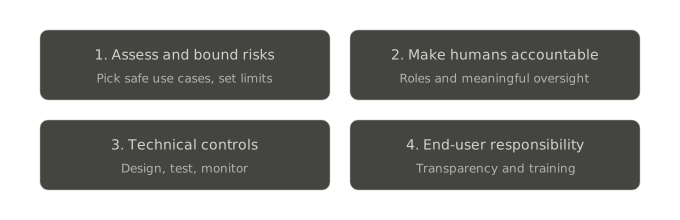
Dayos is one of 14 industry case studies featured in the framework. Our entry sits in the "Assess and bound the risks upfront" dimension, alongside OCBC, PwC, Workday, Tencent, Google, and GovTech. We are happy to be there.
But the more important thing for the market right now is not the framework itself. It is what the framework makes visible about the cost structure underneath enterprise back-office software, and how that cost structure is about to change.
The thirty-year configuration era is ending
For the last thirty years, the enterprise back-office has been a systems engineering problem. The work was configuration. A typical Oracle Cloud or Workday implementation costs between $5 million and $40 million. The reference set is public record: DFW Airport at $41.4 million on Oracle, Blue Shield California at $25 million on Oracle Cloud (which I led), City of Sunnyvale at $16 million, City of Chattanooga at $8.4 million, City of Redwood City at $6.5 million. Industry-wide, the cumulative customer sunk cost across the installed base is approximately $320 billion.
Once a customer is live, they spend roughly another $1 million per year on managed services to keep the system running. Public-record per-ticket pricing from city government Oracle Cloud customers shows a range from $1,744 at the low end (Redwood City) to $4,722 at the high end (Chattanooga), with an industry average of $3,233 per support ticket. Roughly 30 percent of every ERP runs on manual workarounds that nobody can self-service.
The price per ticket is not set by the supply of labor. It is set by the absence of it.
Two million computer science students graduate globally every year. Almost none of them are trained on Oracle, Workday, or SAP. The labor model that has carried enterprise back-office support for thirty years has no pipeline behind it.
The work does not go away. It moves to AI.
What software economics looks like for this work
The IMDA framework defines an agent as a software system built on a reasoning model, with instructions, memory, planning, tools, communication protocols, controls, and logging. The framework also draws a sharp distinction between two dimensions: action-space (the range of actions the agent can take, determined by its tools and permissions) and autonomy (the degree to which it decides how to act).
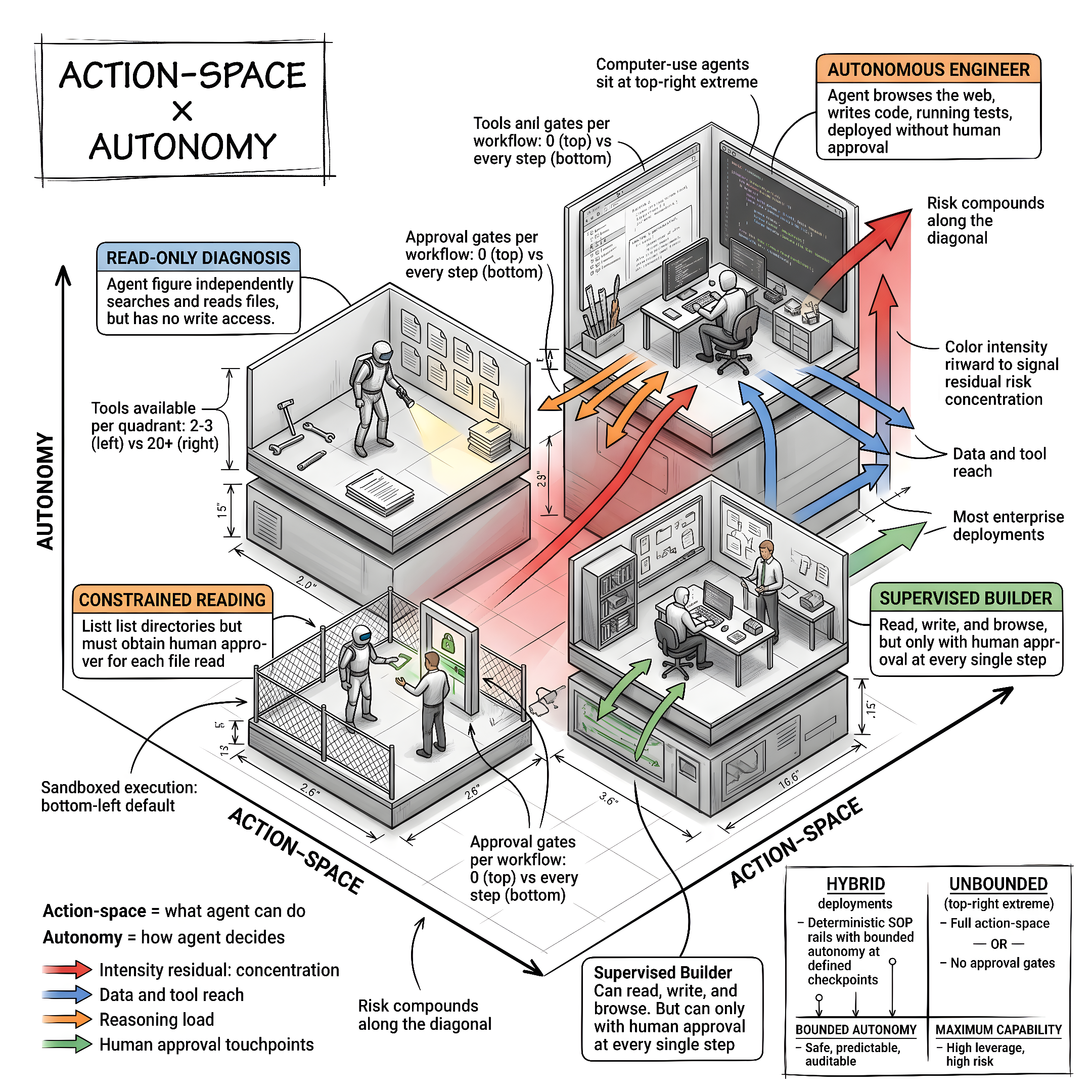
These criteria matter because they are the architecture for a system that can do the work without needing a seat licence. Traditional ITSM platforms were built for deflection and routing. They are workflow automation systems. They are not designed to perform multi-step reasoning across Oracle and Workday, and they are not priced to. They are priced per seat, because the platform is still organised around humans doing the work.
Hero, our platform, was built against the architecture the IMDA framework describes. Hero Starter is $60,000 per year, flat. Hero Pro is $150,000 per year all-in. Hero Enterprise, which retires the original implementation entirely and includes embedded forward-deployed engineers, is $1.5 million to $3 million one-time. That is the same scope traditional system integrators bill at $5 million to $40 million, delivered on software economics.
A year of Hero Starter costs less than twenty support tickets at the industry average.
The case study, by the numbers
We retired our own ServiceNow ITSM in 45 days, reducing annual licensing costs by $121,000. The replacement is the AI-powered ticketing agent now documented in the IMDA framework. It handles every internal IT request that comes in.
Before any of it went live, we ran a structured risk assessment, scoring every ticket type against three questions: how bad is it if the agent gets this wrong, can the action be undone, and is it realistic for a human to review this at each step.
The scores produced three tiers:
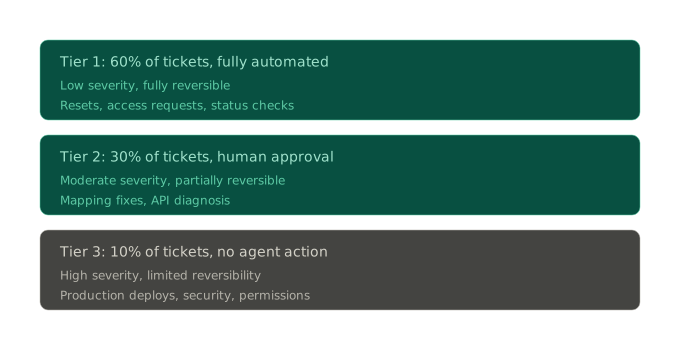
Tier 1 (60% of tickets): Password resets, access requests, status enquiries. Fully automated using a Simple Feedback strategy. Every action produces a reasoning chain. Biweekly audits.
Tier 2 (30% of tickets): Chart of accounts updates, integration mapping corrections, diagnosing failed API connections. The agent uses ReAct, a multi-step diagnostic loop, and writes a diagnostic summary with a proposed fix. A qualified engineer signs off before execution.
Tier 3 (10% of tickets): Production deployments, security changes, permission modifications. The agent does not touch these. As multi-agent verification and real-time anomaly detection mature, we will reassess. Not today.
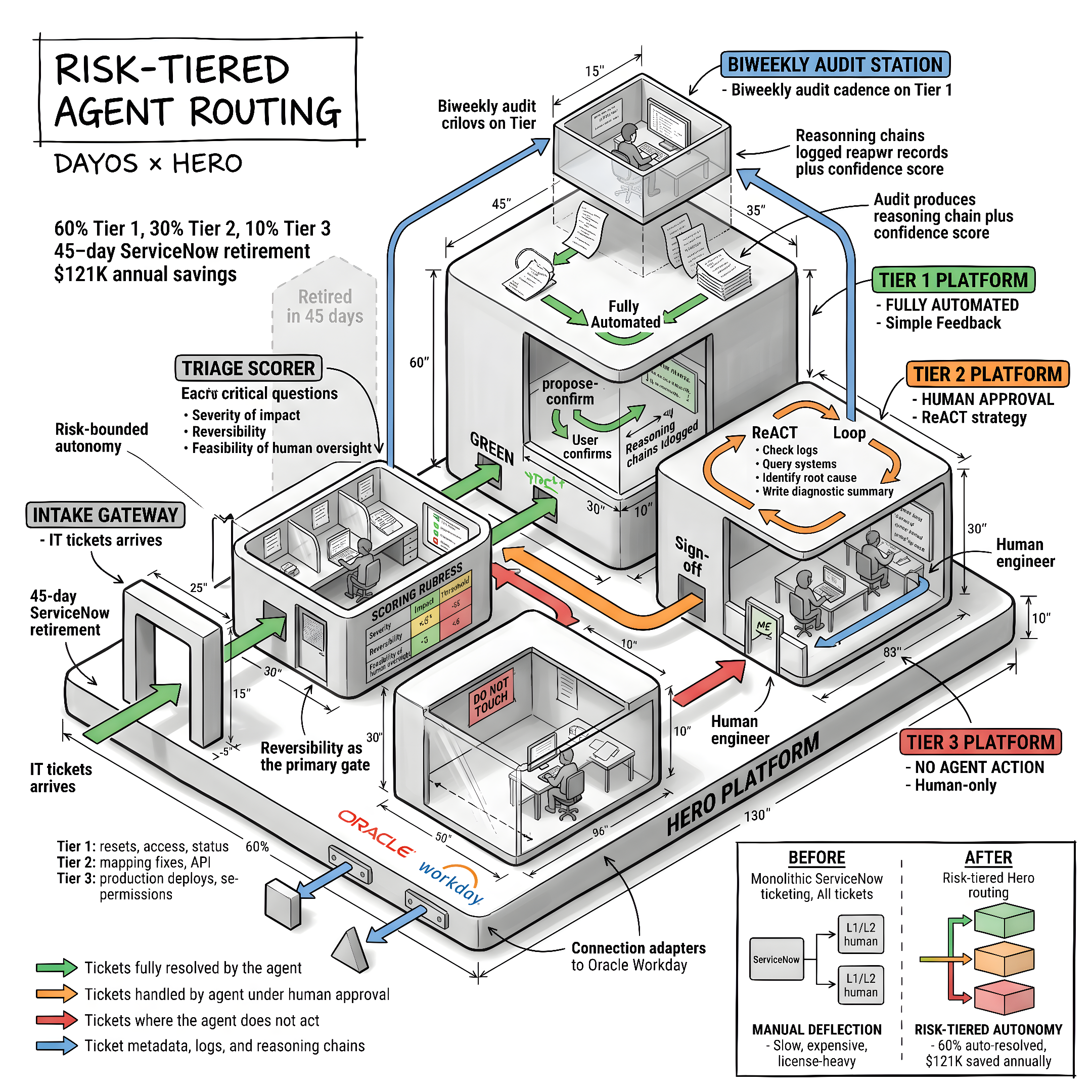
This is what the IMDA framework calls bounding the agent's authority by severity, reversibility, and feasibility of oversight. It is also what SOC 2 Type 2 and ISO 42001:2023 controls require, and what financial audit committees recognise as a defensible system of record.
The ServiceNow retirement is the first proof point. It is not the full thesis. The same agentic architecture, with the same controls and identity model, is what we point at the implementation surface itself in our Enterprise tier. The framework documents the smaller of the two surfaces. The larger one is the $320 billion already sunk into configuration work that nobody can migrate off.
What this means for the buyer
If you are running an Oracle Cloud or Workday tenant today, your cost structure looks something like this:
Between $5 million and $40 million sunk into the original implementation, mostly paid to a system integrator
Roughly $1 million per year ongoing to a managed services vendor
Roughly $3,233 per support ticket at industry average
A labor supply that is not growing
Traditional ITSM support tools do not automate the work
System integrators get you live. Managed services keep you running. Hero replaces both.
The IMDA framework now describes the architecture of the system that replaces this cost structure. It is not a marketing definition. It is a published technical specification, validated against 14 real industry deployments, including ours.
The customer that runs an Oracle Cloud or Workday tenant at $1 million per year in support spend is currently writing a check every twelve months for what Hero Starter delivers, with deployment in two weeks. If your AI vendor cannot map their product to the eight components in the IMDA framework, they are selling labor with a chat interface. The labor model has no pipeline behind it. The math will keep getting worse.
Thirty years of configuration is ending. The next thirty belong to AI-native services.
If you want to walk through how this maps to your environment, we are easy to find.
The full IMDA Model AI Governance Framework for Agentic AI v1.5 is available at imda.gov.sg. The Dayos case study appears in Section 2.1 of the framework.