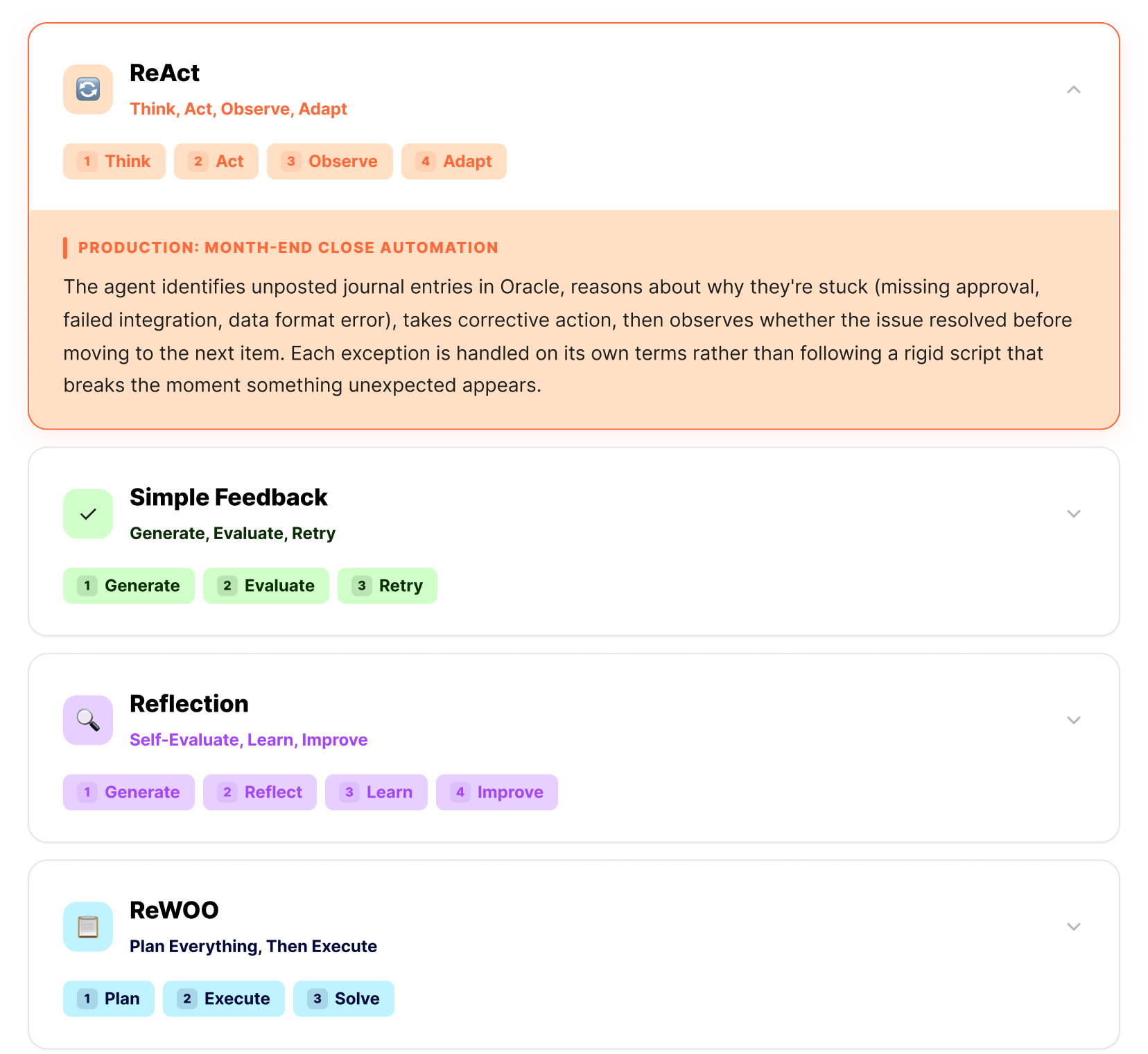
ReWOO: Plan Everything, Then Execute

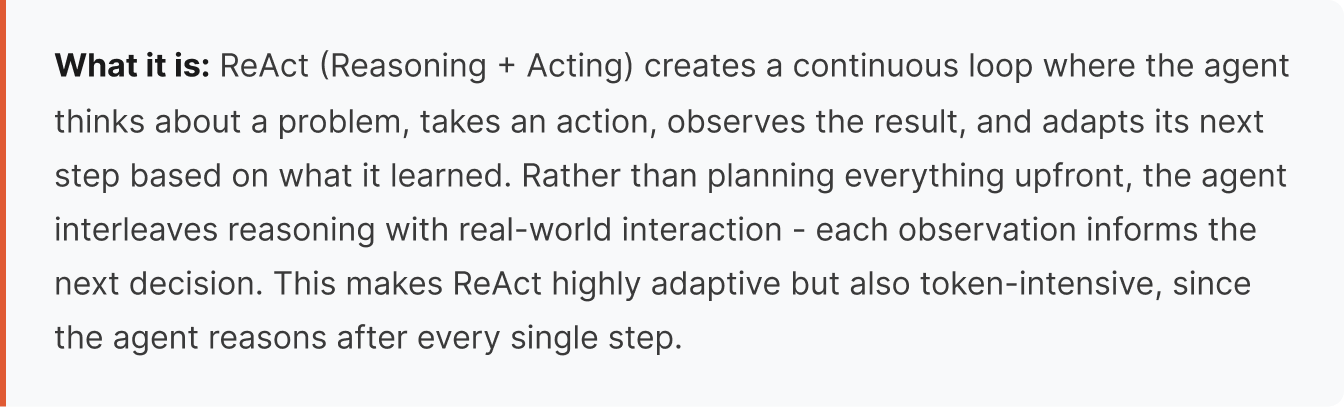
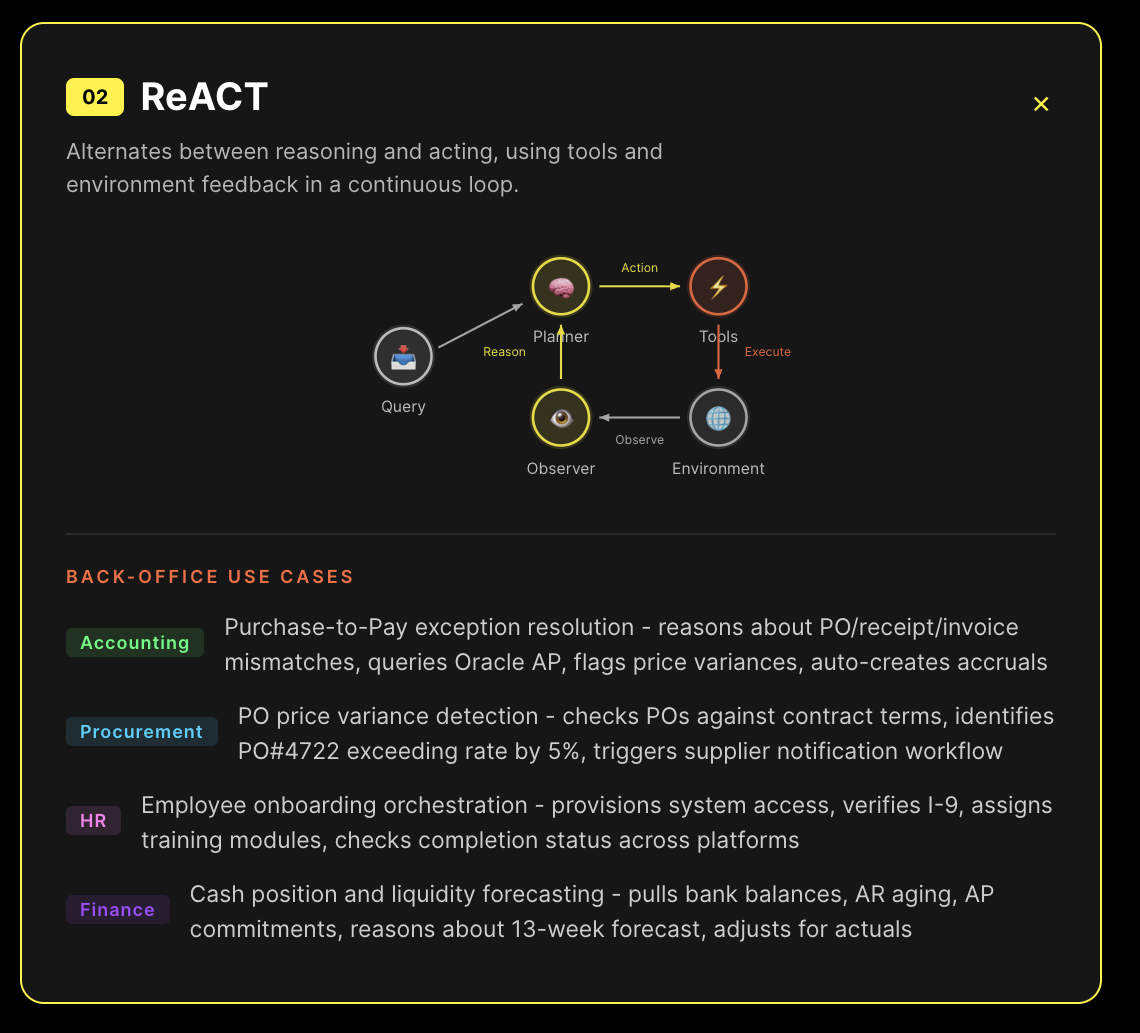
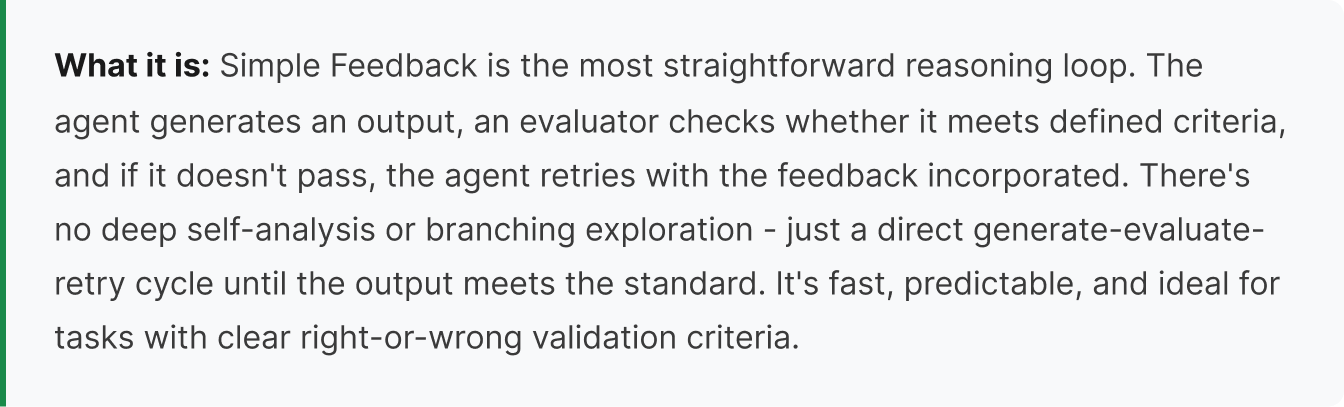
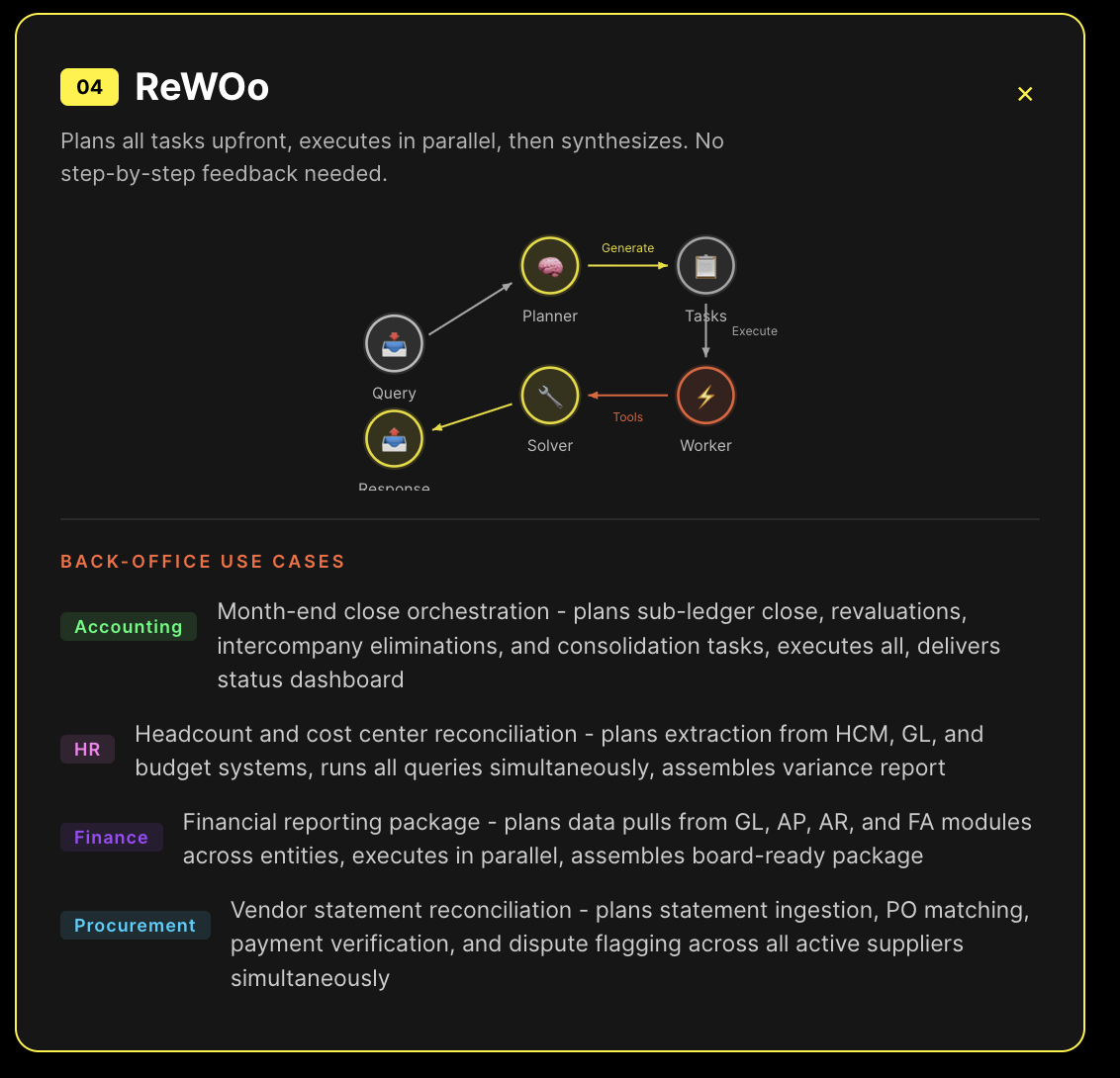
What it is: ReWOO (Reasoning Without Observation) flips the ReAct model on its head. Instead of interleaving reasoning with action at every step, ReWOO separates the process into three distinct phases: a Planner maps out the entire workflow upfront and identifies every piece of information needed, Workers execute all the tool calls and data retrieval (potentially in parallel), and a Solver synthesizes all the gathered results into a final answer. The agent reasons once at the beginning and once at the end - with no LLM calls between tool executions. This makes ReWOO dramatically more token-efficient and faster for structured, repeatable workflows where the steps are known in advance.
Where we use this: External Reconciliation
External reconciliation is one of the hardest problems in enterprise finance because the agent is comparing documents from outside the organization against internal records - and the external documents come in every format, language, naming convention, and template imaginable.
We built a reconciliation agent for a global enterprise that receives over 4,000 documents annually from 250+ external counterparties across 30+ countries. Each counterparty sends their version of the same standard document types, but in their own templates and formats. One country sends clean Excel files. Another sends scanned PDFs with handwritten amendments. A third uses naming conventions that bear no resemblance to the internal system's records.
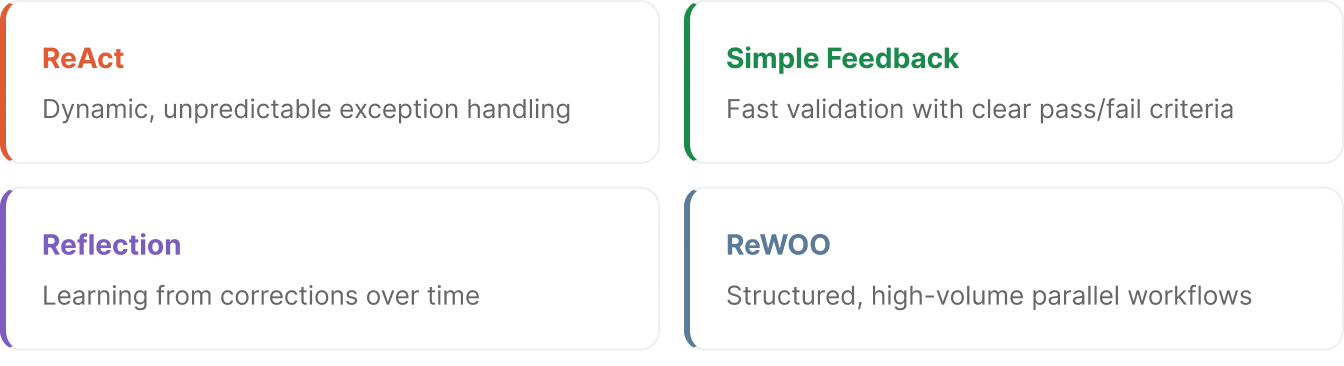
ReWOO is the right strategy here because reconciliation is fundamentally a structured, repeatable workflow. The Planner already knows the steps: extract data from the external document, normalize it, pull the corresponding internal records, match line items, calculate variances, and generate a summary. These steps don't change between submissions - what changes is the content.
This aligns with how finance teams already work: close calendars, reconciliation schedules, and reporting cycles are planned upfront. ReWOO succeeds because it mirrors an existing operational structure rather than introducing a new one.
The Planner maps out the full extraction and matching plan for each document, including which extraction approach to use based on the counterparty's known profile (template-based for clean Excel files, semantic extraction for unrecognized formats, OCR with handwriting recognition for scanned documents). Workers then execute all extractions and data pulls in parallel - grabbing the external document data, the internal accrual records, the counterparty's historical profile, and any relevant currency or rate tables simultaneously. No waiting between steps. No LLM reasoning after each tool call.
The Solver then takes all that gathered evidence and produces the reconciliation output: matched items, variances with root-cause explanations (naming mismatch, rate difference, volume dispute, missing entries due to data lag), and recommended actions. Country profiles - AI-managed validation rules tailored to each counterparty's known template format, naming conventions, and historical submission patterns - make the Planner smarter over time. The agent learns which extraction strategies typically succeed for each counterparty, so the plans become tighter and execution confidence increases with every cycle.
First-submission acceptance rates in production went from roughly 60% to 90%, eliminating weeks of back-and-forth that previously extended reconciliation timelines. And because ReWOO batches all the tool execution into a single phase, the agent processes each document with roughly 5x fewer tokens than a ReAct approach would require - which matters when you're processing 4,000+ documents a year.